

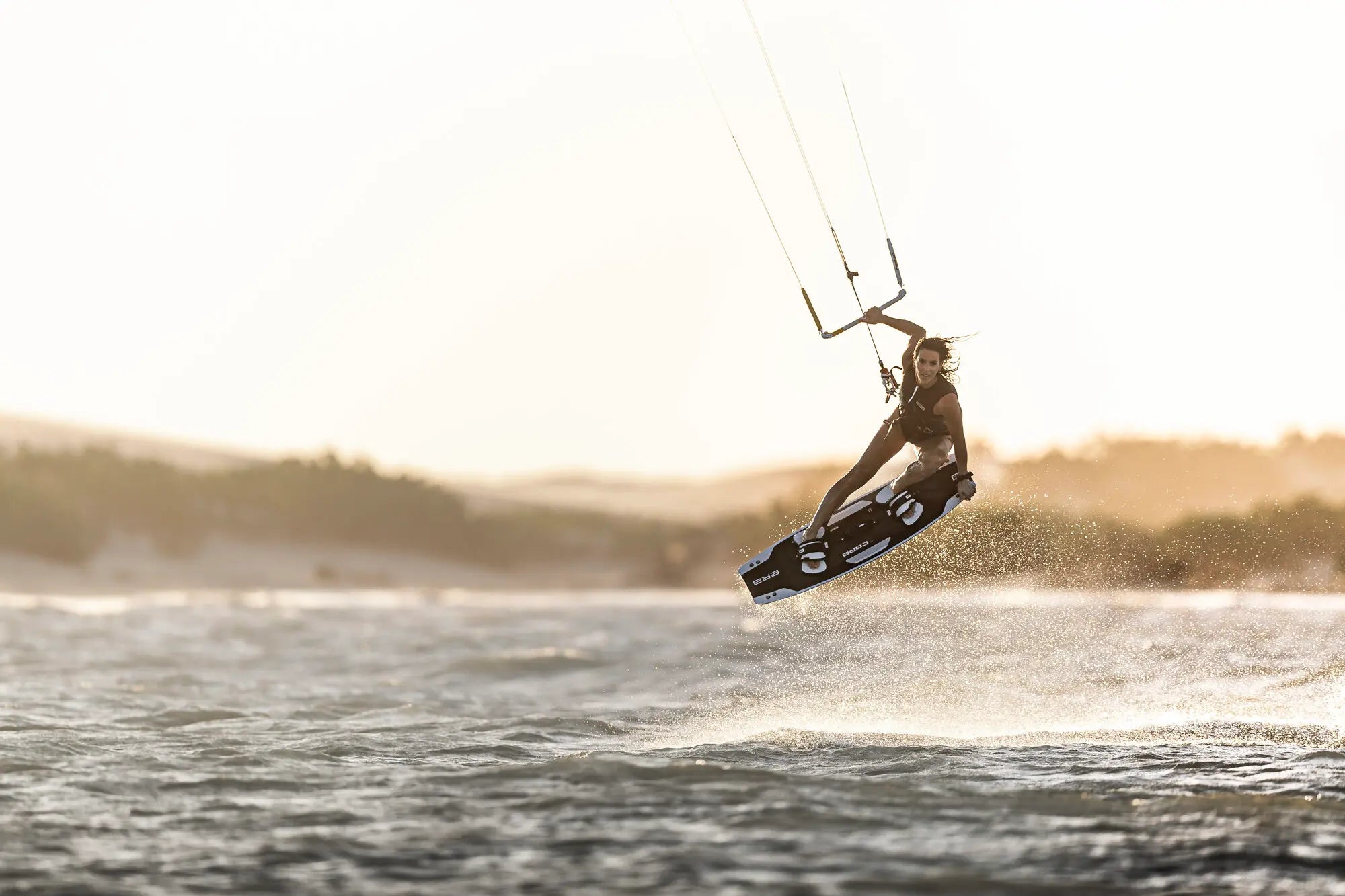
If you are new to wind-powered watersports, you will often hear the terms kitesurfing and kiteboarding used interchangeably. While many people group them together, experienced riders know there is a meaningful distinction, especially when it comes to the board being used and the style of riding.
At Jupiter Watersports, we differentiate these two disciplines clearly. While both use the same kite systems, bars, lines, and harnesses, the board choice defines the discipline.
Below, we break down the real difference between kiteboarding and kitesurfing so you understand what each one is, how they ride differently, and which style may be right for you.
The Short Answer
Kiteboarding typically refers to riding a twin-tip board, while
Kitesurfing refers to riding a directional surf-style board.
The kite itself is the same. The riding experience is not.
What Is Kiteboarding?
Kiteboarding is most commonly associated with twin-tip boards. These boards are symmetrical, meaning they can be ridden in either direction without turning the board around.
Twin tips are always ridden with bindings or foot straps, which keep the board attached to the rider’s feet.

This setup is ideal for:
- Big air jumps
- Freestyle tricks
- Riding flat water
- Riding both directions without switching stance
Because of the bindings and symmetrical shape, kiteboarding allows riders to load up power, edge hard, and boost vertically. This is the style most people think of when they see high jumps and tricks in kite videos.
What Is Kitesurfing?
Kitesurfing, as we define it at Jupiter Watersports, refers to riding a directional surf-style board with a kite.
These boards look very similar to traditional surfboards:
- One pointed nose
- Fins on the tail
- Designed to ride in one direction
Unlike twin tips, kitesurf boards are not typically ridden with bindings. Most riders use wax or a textured deck pad for traction. Some riders add foot straps, especially for jumping or aggressive riding, but many prefer a strapless setup.

Kitesurfing is primarily about:
- Riding waves
- Surf-style carving
- Down-the-line riding
- A more fluid, surf-inspired feel
Same Kite, Different Boards
One important thing to clarify is that kiteboarding and kitesurfing use the same kites. The difference is not the kite itself, but how the rider interacts with the water through the board.
Both disciplines use:
- Inflatable leading-edge kites
- The same control bars and lines
- Harnesses and safety systems
What changes is how the board behaves under your feet.
Riding Feel: Twin Tip vs Directional Board
Kiteboarding (Twin Tip Feel)
- Locked-in feel due to bindings
- Strong edge control
- Easy riding in both directions
- Ideal for jumps and tricks
Kitesurfing (Directional Feel)
- Surf-style carving
- More freedom of movement
- Requires footwork and board control
- Excels in waves and swell
Neither is better. They are simply different experiences.
Which One Should You Choose?
Choose kiteboarding if you want:
- Big air and freestyle riding
- A forgiving, symmetrical board
- Strong edging and jumping performance
- A setup that feels secure and predictable
Choose kitesurfing if you want:
- Wave riding and carving
- A surf-style experience
- Strapless or minimal-strap riding
- A more fluid, surf-inspired feel
Many experienced riders do both, switching boards depending on conditions.
What About Kite Foiling?
There is also a third discipline that continues to grow in popularity: kite foiling.

Kite foiling uses a small directional board with a hydrofoil mounted underneath. This allows the rider to lift above the water and ride efficiently in lighter wind. Kite foiling has even been featured in the Olympics, highlighting how fast and technical the discipline has become.
While kite foiling is different from both kiteboarding and kitesurfing, it still uses the same core kite systems.
Final Thoughts
While kitesurfing and kiteboarding share the same roots and equipment, the board defines the discipline.
At Jupiter Watersports, we make that distinction clear:
- Kiteboarding is twin tip riding with bindings
- Kitesurfing is directional board riding inspired by surfing
Understanding the difference helps you choose the right board, ride the right conditions, and progress faster in the style that fits you best.
If you have questions about boards, setups, or which discipline makes sense for your riding goals, the team at Jupiter Watersports is always happy to help.


